ICMAI CMA Syllabus 2026:
Expected Changes, Timeline & What Students Should Know:
The Institute of Cost Accountants of India (ICMAI) has taken the first concrete step toward a new CMA Syllabus 2026. While the full structure has not been officially released yet, the Institute has issued an Expression of Interest (EOI) inviting experienced professionals to apply as authors and reviewers for the new study material — a clear signal that the syllabus revision process has formally begun.
If you’re a current or prospective CMA student, here’s a calm, fact-based look at what is confirmed, what is still expected, and what it means for your preparation — without the panic.
Quick note on this article: Apart from the EOI itself, most details below are anticipated based on ICMAI’s pattern in previous transitions (notably Syllabus 2016 → Syllabus 2022). Nothing here should be treated as final until ICMAI publishes the official notification. We’ll update this page as more details are confirmed.
What has ICMAI actually confirmed so far?
The one confirmed development is this: ICMAI has released an EOI (Expression of Interest) inviting authors and reviewers to help develop the study material for the upcoming CMA Syllabus 2026.
This matters because authoring and reviewing study material is typically the first stage of any ICMAI syllabus overhaul. Content is drafted, then academically reviewed, and only then released to students. In other words, the wheels have started turning — but the destination (the final syllabus structure) is still being shaped.
The last major revision was Syllabus 2022, and ICMAI has historically refreshed the CMA curriculum roughly every four to five years to keep pace with market and regulatory changes. A 2026 update fits squarely within that cycle.
Why is ICMAI updating the CMA syllabus?
The broad intent behind the revision appears to be making CMAs more globally relevant, technology-aware, and industry-ready. The finance profession is shifting away from purely traditional cost-auditing roles and toward strategy, analytics, and digital decision-making — and the curriculum is expected to reflect that.
Put simply, the goal seems to be producing management accountants who are strategists and analysts, not just number-crunchers.
CMA Syllabus 2026: Key changes students can expect
The following are anticipated directions, not confirmed inclusions. They’re drawn from the EOI’s hints and ICMAI’s stated emphasis areas. Treat them as a likely shape of things to come.
1. A stronger focus on technology
Expect greater integration of AI tools, Data Analytics, and Digital Technology into the curriculum — reflecting how modern finance teams actually work day to day.
2. IFRS-aligned Financial Accounting & Reporting
Financial Accounting and Reporting is expected to lean further into IFRS (International Financial Reporting Standards), supporting the goal of global alignment.
3. Deeper Strategic Financial Management
A stronger emphasis on Strategic Financial Management is anticipated, pushing students toward higher-order, decision-focused thinking.
4. Specialised audit areas
New or expanded coverage of Forensic Audit, System (IS) Audit, and Social Audit could feature — niche but increasingly relevant audit disciplines.
5. Possible subject merging and restructuring
There may be reshuffling, renaming, or merging of existing papers rather than an entirely new subject list. For example, areas like Financial Management and Costing could potentially be combined.
6. A possible move to fewer subjects
One widely discussed possibility is that ICMAI may follow a CA-style structure by reducing the number of subjects— potentially from 8 to 6 at both the Intermediate and Final levels (currently four papers in each of two groups). This remains speculative until officially confirmed.
CMA Syllabus 2026 expected timeline (indicative)
The timeline below is indicative and based on ICMAI’s previous transition pattern — it has not been formally locked by the Institute.
| Stage | Expected period |
| Study material development & rollout | 2026 |
| First exam appearance under new syllabus | June 2027 term |
| Dual-syllabus window (old + new running together) | June & December 2027 |
| Full migration to Syllabus 2026 (Syllabus 2022 phased out) | June 2028 term |
A key reassurance here: in past transitions, ICMAI has run both the old and new syllabus side by side during the changeover year, giving students a buffer to complete their current attempts. The same dual-syllabus arrangement is expected for 2027.
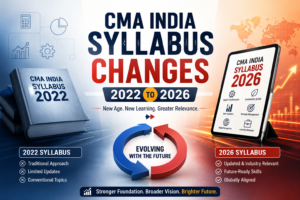
CMA Syllabus 2026 vs Syllabus 2022: what’s the likely difference?
| Area | Syllabus 2022 | Syllabus 2026 (expected) |
| Technology focus | Limited | AI, data analytics, digital systems |
| Financial reporting | Standard coverage | Stronger IFRS orientation |
| Audit | Conventional audit areas | Possible Forensic / System / Social audit |
| Subject count | 8 at Inter & Final | Possibly reduced to 6 |
| Structure | Current grouping | Potential merging/restructuring |
(Comparison reflects anticipated changes; final details await official notification.)
What should current CMA students do right now?
If you’re already preparing, here’s the short version: don’t panic, and don’t pause.
- Keep studying the current (2022) syllabus. It remains fully valid for upcoming attempts, and rushing or stalling your preparation now would only hurt you.
- Aim to clear your levels before the migration deadline so you’re not caught mid-transition.
- Watch official ICMAI channels (icmai.in and the student portal) for the formal notification — that’s the only source that makes any of the above concrete.
- Don’t over-invest in unverified “2026 study material” until ICMAI confirms the structure and releases its own content.
ICMAI has consistently provided ample transition time in past revisions, and there’s no indication this round will be any different.
~ Salil J. Chavan
Qualified CMA (India)
Saraswat Bank